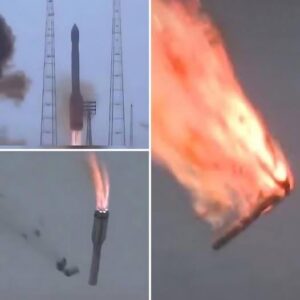
A Historic Day Turns Tragic: Reports Claim China Launched Two Rockets—Both Allegedly Failed
What was supposed to be a landmark day for China’s space ambitions instead became a moment of confusion, concern, and global scrutiny after unverified reports began circulating that two Chinese rockets launched on the same day experienced serious failures. While officials have not released full confirmation and investigations remain ongoing, the claims alone were enough to send shockwaves through the international aerospace community, reigniting debates about transparency, safety, and the razor-thin margins that define modern spaceflight.
A Day Meant to Showcase Progress
Over the past two decades, China has steadily built one of the world’s most ambitious space programs. From crewed missions and space station modules to lunar exploration and satellite constellations, launch days are often framed as symbols of national pride and technological maturity. A dual-launch day—if successful—would have underscored operational confidence and industrial scale.
Instead, social media posts, amateur tracking data, and fragmented reports suggested something went wrong—twice.
According to early claims, one rocket reportedly suffered a malfunction shortly after liftoff, while another allegedly failed to reach its intended orbit, triggering speculation about systemic issues rather than an isolated incident. Chinese authorities have acknowledged “anomalies” in past launches, but as of now, no detailed official statement has confirmed two failures on the same day.
That gap between claims and confirmation is where the story becomes complicated.
How Rocket Failures Usually Unfold
Rocket launches are among the most complex engineering feats humans attempt. Millions of components must work in perfect sequence under extreme stress. Even for mature spacefaring nations, failures are not unheard of.
Typically, when a launch goes wrong, agencies follow a familiar pattern:
-
Telemetry review to pinpoint the anomaly
-
Temporary suspension of related launches
-
Independent review panels
-
Public statement, often limited in detail
In China’s case, information is often released more cautiously, which can create an information vacuum—one quickly filled by speculation.
What Might Have Gone Wrong?
Analysts reviewing publicly available data have floated several possibilities, stressing that these are hypotheses, not confirmed causes:
-
Upper-stage engine anomalies, which can prevent payloads from reaching orbit
-
Guidance or control failures, leading to trajectory deviations
-
Structural or separation issues, especially during stage transitions
-
Quality-control problems, particularly if rockets share common components
If two launches truly failed within hours of each other, investigators would likely examine whether both vehicles relied on similar subsystems or manufacturing batches.
The Human and Environmental Stakes
Beyond national prestige, rocket failures carry real risks. Debris can fall back to Earth, sometimes over populated areas. In past incidents, falling rocket stages have landed near villages, raising concerns about civilian safety and environmental contamination.
A double failure—if confirmed—would intensify calls for stricter safety protocols, more transparent tracking, and improved international coordination when launch debris threatens shared airspace or maritime zones.
Global Reactions: Concern, Not Celebration
International responses to the reports were notably restrained. Space agencies and defense analysts avoided public accusations, instead emphasizing the need for verified data. Privately, however, experts acknowledged that two failures in one day would be statistically significant, especially for a program that prides itself on reliability.
Rival space powers understand the stakes. A setback for one major player affects satellite markets, launch insurance rates, and even geopolitical calculations tied to space-based infrastructure.
Transparency in the Modern Space Race
One of the core issues highlighted by this episode is transparency. In today’s world of real-time tracking, independent observers, and open-source intelligence, it’s increasingly difficult for any space agency to fully control the narrative.
When official updates are slow or vague, speculation accelerates. That doesn’t mean the worst claims are true—but it does mean silence can be costly.
Clear communication, even when news is bad, tends to stabilize public trust.
If Confirmed, What Comes Next?
Should Chinese authorities confirm that two rockets failed on the same day, several outcomes would be likely:
-
Temporary grounding of affected launch vehicles
-
Delays to satellite deployments or scientific missions
-
Internal audits across manufacturers and launch centers
-
Increased scrutiny from international insurers and partners
Historically, space programs that respond decisively to failure often emerge stronger. Lessons learned under pressure can lead to safer, more robust systems.
A Reminder of How Hard Space Really Is
Whether these reports ultimately prove accurate or overstated, the episode serves as a powerful reminder: spaceflight is unforgiving. Even advanced programs operate at the edge of physics, materials science, and human precision.
A single miscalculation can turn a historic day into a cautionary tale.
For now, the world waits for clarity. Until official findings are released, the story remains one of uncertainty—caught between rumor and reality. But one thing is certain: every launch, successful or not, reshapes the future of space exploration.
And sometimes, the most important moments aren’t the triumphs—but how nations respond when things go wrong.