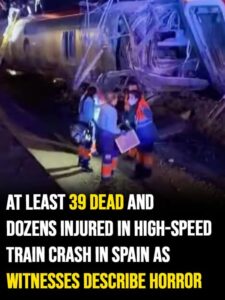
A Night of Horror on Spanish Rails: At Least 39 Dead and Dozens Injured
On the evening of January 18, 2026, what should have been an ordinary high-speed rail journey turned into one of the deadliest train disasters in Spain in years. Two high-speed trains collided in the province of Córdoba in southern Spain after one train derailed and crossed onto the opposite track, slamming into another high-speed service. As of the latest official reports, at least 39 people have died, and dozens more are injured, with some critically so.
Spanish authorities immediately characterized the incident as a “night of deep pain” for the country—a phrase used by Prime Minister Pedro Sánchez as rescue workers and emergency crews began one of the most complex recoveries in recent memory.
The Crash: What Happened
The collision occurred near the small municipality of Adamuz, in Andalusia, on a section of track that forms part of Spain’s extensive high-speed rail network—the Madrid–Seville/Andalusia line. One of the trains, operated by the private company Iryo, was traveling northbound from Málaga to Madrid when it suddenly derailed.
According to authorities, carriages from this train jumped the rails and crossed over onto the opposite track, where they collided with another high-speed train operated by RENFE, which was heading south from Madrid toward Huelva. Both trains then derailed amidst the violence of the impact.
Eyewitness accounts from survivors and nearby residents describe the collision as horrific. One passenger later recounted feeling a violent jolt as the train derailed—like an “earthquake”—before coming to a sudden stop and plunging into darkness. People were thrown from their seats, luggage flew through carriages, and panic spread as glass shattered and twisted metal crushed parts of the train.
Casualties and Rescue Efforts
Initial reports confirmed at least 39 fatalities, although officials cautioned that this number could rise as rescue operations continued and bodies were recovered from the wreckage. Dozens more—official counts indicate well over 100—were injured, with many suffering serious trauma. Some were transported by ambulance to hospitals in Córdoba and surrounding provinces, while others were treated at field hospitals near the crash site.
Emergency responders worked through the night under grueling conditions, contending with wreckage, overturned carriages, and challenging terrain. Firefighters, paramedics, the Guardia Civil, and specialized rail accident teams coordinated to free trapped passengers, treat the wounded, and recover the deceased.
Local residents also played a heartbreaking role. People from nearby towns brought vehicles, blankets, and food, rushing to help survivors escape the wreckage or transport the injured before official help could arrive. One local recalled the scene as chaotic and terrifying—voices calling for help, cries of pain, and a desperate struggle to reach loved ones.
Government and Political Response
Prime Minister Pedro Sánchez condemned the disaster and pledged a full, transparent investigation into how such a catastrophic accident could occur on a high-speed line in one of the world’s most advanced rail systems. The government declared three days of national mourning, and flags were flown at half-mast across Spain.
Transport Minister Óscar Puente described the crash as “extremely strange,” noting that the section of track where the derailment occurred had been recently upgraded and that the Iryo train itself was relatively new. Officials were working to determine whether infrastructure failure, a rail fracture, or another mechanical issue was to blame.
The Spanish Royal Family and religious leaders also offered condolences. Pope Leo XIV expressed deep sorrow for the victims and their families, emphasizing prayer and solidarity with all affected.
Investigation and Causes
Investigators from Spain’s Railway Accident Investigation Commission (CIAF) and other technical bodies immediately began combing the site for evidence. Early assessments focused on the track and the sequence of events leading to the initial derailment. Because the trains were traveling at high speed on a straight section of track that had been refurbished months earlier, experts were baffled and sought explanations beyond simple error or maintenance lapse.
Preliminary findings from some unofficial sources suggest that a fracture or defect in the rail may have played a central role in destabilizing the first train, although this has not been officially confirmed. The speed and force with which the train derailed left little time for automatic safety systems to react before the collision.
Understanding what happened will not only involve technical analysis of the track and train components but also a review of maintenance records, safety inspections, and operational protocols. With many victims still in critical condition, authorities have said that identifying all the deceased may take additional time, requiring DNA and family correlation efforts.
Witness Accounts: Horror and Survival
Survivors have offered stark testimony about the chaos inside the carriages. One witness described the jolt that threw passengers forward, punctuated by the screech of metal and the sound of seats smashing into one another. People reported breaking windows to escape when doors became jammed. Glass and debris caused many of the injuries, compounded by the impact of carriages colliding at speed.
Another passenger said, “This looks like a horror movie,” capturing the shock and disbelief that many felt as the situation unfolded in seconds but left scars that will last a lifetime.
Wider Impact and Reaction
Spain’s reputation for safe, efficient high-speed rail travel—one of the most extensive networks in Europe—makes this disaster especially jarring. High-speed trains are generally considered among the safest methods of travel, and collisions of this magnitude are exceedingly rare.
This has sparked intense public debate about rail infrastructure maintenance and safety prioritization. Some critics have pointed to long-term underinvestment in upkeep despite recent expansions of the network, arguing that modernization must be matched with rigorous safety checks and continual oversight.
Families of the victims and survivors are demanding answers. At memorial gatherings and funerals, emotional appeals underscored not just grief but a desire for accountability and assurance that such a tragedy will not repeat.
Remembering the Victims
As Spain mourns, communities across the country have held vigils, laid flowers at train stations, and shared photos and stories of those lost. For many, the tragedy is deeply personal—family members and loved ones taken without warning, journeys that ended in unimaginable suffering.
The rescue and recovery operations continue, with medics treating injuries and authorities working to piece together the full story. While the death toll currently stands at at least 39, officials caution that it may rise as more information becomes available.