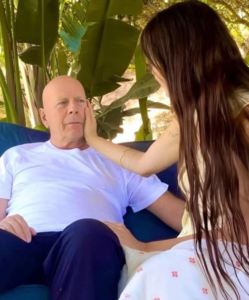
Bruce Willis and the Strength of Family: A Quiet Life Beyond the Spotlight
For decades, Bruce Willis was synonymous with action-hero bravado and charismatic resilience. From the wisecracking cop John McClane in Die Hard to complex dramatic turns in The Sixth Sense and Unbreakable, Willis carved out a place in Hollywood defined by toughness, wit, and a surprising emotional range. Yet in recent years, the public image of Bruce Willis has shifted—away from box-office dominance and toward something far more intimate and profound: the strength of family, quiet dignity, and life beyond the spotlight.
The transition was not one Willis sought, nor one shaped by creative reinvention or retirement on his own terms. Instead, it emerged from deeply personal health challenges that altered the course of his career and life. In stepping back from acting, Willis revealed another kind of heroism—one grounded not in spectacle, but in love, vulnerability, and connection.
A Career Built on Presence
Bruce Willis rose to fame in the 1980s with Moonlighting, where his sharp humor and easy charm made him a household name. Hollywood initially struggled to imagine him as an action star—until Die Hard redefined the genre. Willis didn’t play an invincible superhero; he played a tired, injured, sarcastic man who endured. That humanity became his signature.
Over time, Willis proved he was more than an action lead. He took risks, embraced unconventional roles, and collaborated with visionary directors. His performances often relied on subtlety—pauses, glances, restraint—suggesting an actor deeply aware of how presence can speak louder than dialogue. Ironically, it was this very quality that made his later absence from the screen so noticeable.
Stepping Away with Grace
When news emerged that Willis would be stepping back from acting due to health concerns, the announcement was shared not by publicists or studios, but by his family. The message was clear, unified, and compassionate. It emphasized gratitude, transparency, and love—values that would define this new chapter of his life.
Rather than retreating into silence, the family chose honesty, helping the public understand why a beloved actor was disappearing from view. In doing so, they reframed the narrative. This was not a fall from fame, but a deliberate shift in priorities—away from performance and toward presence in its truest sense.
The Power of a Blended Family
Bruce Willis’s life beyond Hollywood is anchored by a strong, blended family. His relationships—with his wife, his former spouse Demi Moore, and his children—have become a powerful example of unity and mutual respect. In an industry often defined by fractured relationships and public feuds, the Willis family stands out for its cohesion.
Demi Moore’s continued closeness with Willis, even years after their divorce, has been especially striking. Rather than distancing themselves, the family came together during a time of need, prioritizing emotional support over past differences. Their public messages reflect not nostalgia or regret, but genuine partnership rooted in shared history and care.
This sense of collective strength has allowed Willis to live with dignity and stability, surrounded by people who know him not as a celebrity, but as a father, husband, and friend.
Redefining Masculinity and Strength
Bruce Willis built a career playing men who fought back against overwhelming odds. Yet his quiet life today offers a different—and perhaps more important—definition of strength. Accepting vulnerability, stepping away from a lifelong profession, and allowing others to care for you requires courage that few public figures openly display.
In this sense, Willis continues to challenge cultural expectations. He shows that strength is not always loud, dominant, or victorious. Sometimes it is gentle. Sometimes it is letting go. Sometimes it is choosing love over legacy.
Life Beyond the Spotlight
Away from film sets and red carpets, Willis’s days are reportedly simple and grounded. Time with family, familiar routines, and moments of calm have replaced the relentless pace of Hollywood. This quieter life may not generate headlines, but it carries its own profound meaning.
For fans, there is a bittersweet quality to this transition. The absence of new performances is deeply felt. Yet there is comfort in knowing that the man who once entertained millions is now surrounded by care, laughter, and understanding—protected from the pressures that once defined his identity.
In a culture obsessed with productivity and relevance, Willis’s retreat is a reminder that a person’s worth does not diminish when their public output stops. Life does not end when the spotlight fades; it simply changes shape.
A Lasting Legacy
Bruce Willis’s legacy will always include his films—iconic lines, unforgettable scenes, and characters that defined eras of cinema. But his legacy is now broader and more human. It includes the way his family has rallied around him, the transparency with which they’ve shared their journey, and the grace with which he has exited a demanding profession.
There is something deeply moving about seeing a man who once embodied cinematic toughness now embraced for his gentleness and humanity. It reminds us that behind every public figure is a private life deserving of respect and care.
Conclusion
Bruce Willis’s quiet life beyond the spotlight is not a story of loss—it is a story of love. It speaks to the power of family, the dignity of acceptance, and the courage it takes to redefine strength when circumstances change. In stepping away from the roles that made him famous, Willis has revealed something even more enduring: the importance of connection, compassion, and peace.
And in that sense, Bruce Willis remains what he has always been—a figure of resilience. Only now, the battle is not fought on screen, but within the sacred, unseen space of family and home.