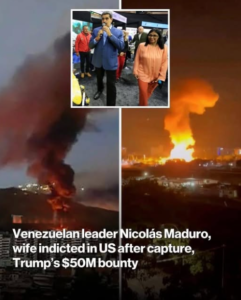
Allegations of a Dramatic Capture: Nicolás Maduro, U.S. Indictments, and the Global Shockwaves That Followed
Claims that Venezuelan leader Nicolás Maduro and his wife are facing sweeping U.S. indictments following a dramatic capture operation have ignited intense global controversy, even as officials and analysts stress that such reports remain highly disputed and unconfirmed. The narrative, fueled by anonymous sources and amplified across international media and social platforms, has sent political shockwaves through Latin America, Washington, and beyond—highlighting the fragile intersection of power, law, and geopolitics.
At the center of the controversy is the assertion that U.S. authorities enforced a long-standing bounty—reported in some claims to be as high as $50 million—following a covert operation that allegedly resulted in Maduro’s detention. While the United States has historically accused Maduro of narcotics trafficking and corruption, including formal indictments announced years earlier, no official confirmation has been issued to substantiate claims of a capture or extradition. The absence of verification has not stopped the story from triggering intense diplomatic fallout.
For years, Nicolás Maduro has been one of Washington’s most prominent adversaries in the Western Hemisphere. U.S. officials have repeatedly characterized his government as authoritarian, accusing it of undermining democratic institutions, suppressing dissent, and profiting from illicit activities. Maduro, in turn, has framed U.S. actions as imperial aggression, using sanctions and legal threats as proof of foreign interference aimed at regime change. The alleged capture narrative fits squarely into this long-running confrontation, which has already reshaped regional alliances.
If such an operation were ever confirmed, its legal implications would be unprecedented. The arrest of a sitting head of state—particularly without the consent of their government—would raise profound questions under international law. Sovereignty, diplomatic immunity, and jurisdiction would all come under scrutiny. Legal scholars note that even indictments against heads of state are rare, and enforcement actions against them are rarer still, often occurring only after removal from power or through international tribunals.
The involvement of Maduro’s wife in these alleged indictments has added another layer of complexity. Family members of political leaders are often implicated in corruption investigations, but prosecuting them alongside a sitting leader would dramatically escalate tensions. Supporters of the Venezuelan government have dismissed such claims as psychological warfare designed to destabilize the country internally and weaken Maduro’s remaining international support.
Across Latin America, reactions have been sharply divided. Governments critical of Maduro have responded with guarded statements emphasizing the rule of law while avoiding endorsement of unilateral actions. Allies of Caracas, however, have condemned the allegations outright, warning that the normalization of cross-border capture operations would set a dangerous precedent. Several regional leaders have called for restraint, arguing that political conflicts must be resolved through diplomacy rather than force or legal shock tactics.
The reported involvement of former President Donald Trump—specifically claims that he confirmed enforcement of a massive bounty—has further inflamed debate. Trump’s prior administration took an aggressive stance toward Venezuela, imposing sweeping sanctions and recognizing opposition leadership as legitimate. Supporters argue that such pressure was necessary to confront corruption and authoritarianism. Critics counter that these tactics worsened humanitarian conditions and hardened political divisions, while failing to achieve lasting change.
Global powers outside the Americas have also taken notice. Russia, China, and Iran—countries that have maintained varying degrees of cooperation with Venezuela—are reportedly monitoring developments closely. Any confirmed action against Maduro would reverberate far beyond Latin America, potentially influencing energy markets, military partnerships, and diplomatic alignments at a time when global tensions are already high.
Inside Venezuela, the psychological impact of such claims has been significant regardless of their accuracy. Supporters of the government have rallied around Maduro, framing the allegations as proof that the nation remains under siege. Opposition figures, meanwhile, have expressed cautious hope mixed with skepticism, aware that false expectations could once again lead to disillusionment if dramatic claims fail to materialize.
Legal experts emphasize that misinformation itself has become a strategic weapon. In modern geopolitical conflicts, narratives can move faster than facts, shaping public opinion before verification occurs. Whether intentional or accidental, exaggerated or fabricated reports can destabilize markets, provoke protests, and force governments into defensive positions. This makes restraint and confirmation more critical than ever.
As of now, no independent international body has confirmed the alleged capture, and Maduro continues to appear in official Venezuelan communications. U.S. authorities have not released statements verifying new enforcement actions beyond existing legal positions. Until such confirmation emerges, analysts urge the public and policymakers alike to treat the story as a reflection of ongoing political warfare rather than a settled historical event.
What this episode undeniably reveals is the volatility of the current global order. The line between law enforcement, diplomacy, and power projection is increasingly blurred. Whether the claims surrounding Nicolás Maduro represent a real turning point or another chapter in information-driven conflict, they underscore how deeply contested leadership, legitimacy, and justice have become on the world stage.
In an era defined by rapid narratives and slow verification, the truth—whatever it ultimately proves to be—may matter less in the short term than the reactions these claims provoke. And those reactions are already reshaping conversations about sovereignty, accountability, and the future of international power.